Monday, February 28, 2005


Sunday, February 27, 2005
It's that time again
Procrastination time!
The wonderful thing about blogging is that it can distract you from your other duties, including writing papers and reading text book chapters. La, la la.
I locked myself out of my room a couple of nights ago; you can imagine the wave of adrenaline I got from that. Visions of sleeping in the hallway outside my door were wafting through my head, but I remembered that one of my friends, Nicole, is an RA, so I ran up to the fourth floor, and she was super nice and got the key. Blehhhh.
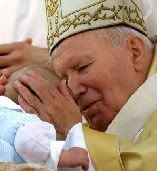
I am so worried about the Pope. He always seems to bounce back from his illnesses, but the thought remains in the back of my mind: One day, he won't bounce back. It will be so disconcerting to have a new Pope; John Paul II was elected about seven years before I was born.
I will miss him terribly ... just thinking about it makes me a bit weepy, LOL :)
The wonderful thing about blogging is that it can distract you from your other duties, including writing papers and reading text book chapters. La, la la.
I locked myself out of my room a couple of nights ago; you can imagine the wave of adrenaline I got from that. Visions of sleeping in the hallway outside my door were wafting through my head, but I remembered that one of my friends, Nicole, is an RA, so I ran up to the fourth floor, and she was super nice and got the key. Blehhhh.
I am so worried about the Pope. He always seems to bounce back from his illnesses, but the thought remains in the back of my mind: One day, he won't bounce back. It will be so disconcerting to have a new Pope; John Paul II was elected about seven years before I was born.
I will miss him terribly ... just thinking about it makes me a bit weepy, LOL :)
Saturday, February 26, 2005
Great Opportunity
Offer a spiritual bouquet for the Pope (click)
You can offer rosaries, Mass intentions, or just promise to say an Our Father or two. What a wonderful way to pray for the Holy Father.
You can offer rosaries, Mass intentions, or just promise to say an Our Father or two. What a wonderful way to pray for the Holy Father.
Friday, February 25, 2005
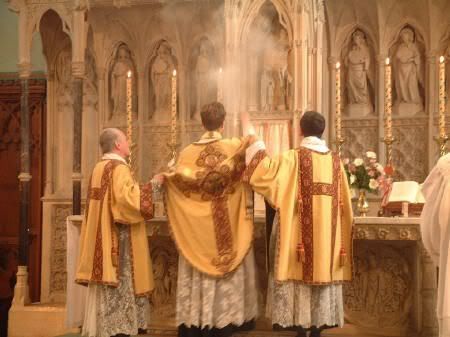
I love the Tridentine Mass, the Order of the Mass which was used for hundreds of years in the Roman Catholic Church before Vatican II. The major differences are that the liturgy is in Latin, the priest faces the same direction as the congregation, and the congregation is much more silent. Although I think the Novus Ordo is superior in some respects, I personally prefer the heightened sense of tradition, Catholicity and mystery of the old ordo. When I'm at home I attend the Latin Mass - strictly in approved Indult situations, of course :)
These priests are from the Priestly Fraternity of St. Peter, or the FSSP. The Tridentine Mass is their apostolate.
See the Latin/English Tridentine Mass parallel text
Thursday, February 24, 2005
Wednesday, February 23, 2005
Ayeeee
Working too much on papers makes me odd. Odder I should say. I guess it should be ... "more odd." Blehhhhhh.
Today I stumbled on this most amusing Florence King column being retread-ed on National Review Online. It was on lady novelists and included several amusing parodies of their work. I particularly enjoyed her bit on Ayn Rand, mostly because in my own little brain I have done similar things. For instance, I always liked to imagine what a hard-core objectivist would do in suburbia:
Scene: Grocery Store
Bagger (I mean, "looter"): Paper or plastic?
Dagny Taggart: Who is John Galt?
or perhaps, in Tunisia:
"The road is cleared," said Galt. "We are going back to the world."
He raised his hand and over the desolate earth he traced in space the sign of the Tunisian dinar.
Or perhaps we could have a Howard Roark in the days before classical Rome who wants to build columns and triglyphs on all his buildings, but who has to fight the dominant traditions of building hovels which were copies of lean-tos which were copies of caves which were copies of ...
For what it's worth, I should point out that I think Ayn Rand was out of her mind most of the time and that objectivism is a bankrupt philosophy that utterly distorts the ideas of legitimate, rational self-promotion and self-interest. However, I have to admit that when I was younger and more cynical (now there's an unusual phrase!) I thought it was the finest set of ideas ever to spring from a mind half-baked, as is testified by my well-worn copies of Atlas Shrugged and The Fountainhead. Although, incidentally, I never finished Atlas Shrugged because I could not wade through Galt's lengthy diatribe. And my intellectual connection with Fountainhead wasn't all that strong; I remember having an irrational dislike for Roark because I have always hated modern architecture, when in fact I should have disliked him because he was an advocate and devotee of of the "virtue" of selfishness. ;)
Today I stumbled on this most amusing Florence King column being retread-ed on National Review Online. It was on lady novelists and included several amusing parodies of their work. I particularly enjoyed her bit on Ayn Rand, mostly because in my own little brain I have done similar things. For instance, I always liked to imagine what a hard-core objectivist would do in suburbia:
Scene: Grocery Store
Bagger (I mean, "looter"): Paper or plastic?
Dagny Taggart: Who is John Galt?
or perhaps, in Tunisia:
"The road is cleared," said Galt. "We are going back to the world."
He raised his hand and over the desolate earth he traced in space the sign of the Tunisian dinar.
Or perhaps we could have a Howard Roark in the days before classical Rome who wants to build columns and triglyphs on all his buildings, but who has to fight the dominant traditions of building hovels which were copies of lean-tos which were copies of caves which were copies of ...
For what it's worth, I should point out that I think Ayn Rand was out of her mind most of the time and that objectivism is a bankrupt philosophy that utterly distorts the ideas of legitimate, rational self-promotion and self-interest. However, I have to admit that when I was younger and more cynical (now there's an unusual phrase!) I thought it was the finest set of ideas ever to spring from a mind half-baked, as is testified by my well-worn copies of Atlas Shrugged and The Fountainhead. Although, incidentally, I never finished Atlas Shrugged because I could not wade through Galt's lengthy diatribe. And my intellectual connection with Fountainhead wasn't all that strong; I remember having an irrational dislike for Roark because I have always hated modern architecture, when in fact I should have disliked him because he was an advocate and devotee of of the "virtue" of selfishness. ;)
Tuesday, February 22, 2005
Down to the wire on this case
Shiavo's brother seeks to educate at campus rally
A group of about a dozen students and activists wearing "Save Terri Schiavo" T-shirts stood outside the Reitz Union on the University of Florida campus at noon Monday.
As students hustled past on their way to lunch, the demonstrators asked passersby to sign a petition calling on Circuit Court Judge George W. Greer to step down from the case that has been fought in the courts for nearly eight years.
Schiavo, now 41, suffered severe brain damage 15 years ago. She resides in a Pinellas Park hospice. Her husband, who has testified that his wife would not want to be kept alive artificially, has asked that her feeding tube be removed.
That order could come from the 2nd District Court of Appeal as early as 1 p.m. today.
Schiavo's brother, 40-year-old Bobby Schindler, was in Gainesville for the rally. Schindler argued that a dozen doctors who have voluntarily looked into his sister's case believe that she could be helped, that with intensive therapy, she could be taught to speak and eat on her own again.
"We are trying to educate people as to the facts of this case," Schindler said. "Nobody knows the facts, because they aren't being reported to the public."
Some doctors have ruled that Schiavo is in a persistent vegetative state with no hope for recovery. Others have said she still has some mental capabilities. She left no written directive for her family or her husband to follow.
What we are dealing with is a woman who left no instructions to take her off life support (let alone stop feeding her, which is an entirely different thing), and in fact, may have implied the opposite to her family and friends. Her husband, after fathering two children with his newly acquired girlfriend, suddenly "remembered" years after the initial injury that his wife had said she "didn't want to live that way." Why doesn't he just walk away, divorce Terri and let her parents take care of her, as they've been begging him to do? Well, guess whose name is on the insurance paperwork, to the tune of $750,000 ...
Read the rest of the story about the rally, and pray for Terri!
Eliza, I know you'll like this one
Since it mentions our favorite Holy Office Inquisitor! ;)
Bishop leaves cradle of Catholicism for WichitaRead it alllll here.
Monsignor Michael Jackels leaves Rome today on his way to becoming the next bishop of Wichita.
Jackels has been living for the past eight years in the cradle of Catholicism, working for the watchdog arm of the Vatican under one of the most powerful men in the church.
That may sound like heady stuff, but Jackels says being named last month as the bishop of Wichita is what's turned his world upside down.
He'll be installed April 4, the week after Easter, during a Mass at the Church of the Magdalen ...
His boss for the past eight years was Cardinal Joseph Ratzinger, head of the Congregation for the Doctrine of the Faith, the Vatican agency that ensures the integrity of Catholic teaching.
After Jackels made his trip to Wichita in January, "I went in to talk with Cardinal Ratzinger. He wanted to know how things went. I said, 'This is very surreal. It's like it's happening to somebody else and not to me.' And it was consoling because he said he had the exact same experience when he was named bishop of Munich and it was not expected."
... Jackels' priestly service comes with a reputation -- the diocese of Lincoln is known as one of the most traditional in the United States, and the congregation in Rome he worked for is the preserver of orthodoxy. Jackels calls himself a watchdog.
He's used to being ribbed about it.
"It's funny because it's an important congregation and we have to deal with the things that are controversial," he said.
Americans don't always understand, for example, why a Catholic theologian teaching in a university might be censured for writing something contrary to Catholic teaching.
"But for a Catholic theologian, they not only have rights but they have duties," Jackels said.
His boss in Rome has a reputation as "the enforcer."
"You hear Cardinal Ratzinger referred to as a panzer -- a tank -- by people. But he's a perfect gentleman, and I'm not saying this for any reason other than it's true. He's a model of Christian and priestly virtues, and you couldn't meet a more kind and gentle person, humble, a warm smile on his face."
Come one come all
Anyone reading this in Athens (ahem) is invited to come with me some Saturday to Eucharistic Adoration. I usually go around seven, and stay for an hour. It's very quiet and peaceful, and no one talks to you; when the priest is finished setting up, he leaves. You don't "do" anything; you can read something appropriate, or of course, pray pray praaaaay! Or just sit there silently and think. It's just you and God; nobody bothers you. It's also a good time to go to Confession, since that's when the priest hears them; he hears them behind a screen in the little chapel in the back - from seven until everyone who wants to confess has been heard :)
I went to Confession Saturday night, right before we all went to Jodie's Excellent Mexican Restaurant Fake Birthday Adventure (from which my intestines are still recovering) and it was wonderful, as always. The priest at St. Paul's is the best confessor I have ever had. He's firm, but he's not one of the "scary" types - I don't think they actually exist - and he never yells. AND the advice is always good. AND there's that little bit about being reconciled to Christ, which is the whole point, after all!
Speaking of "nobody bothering you," that's one of the little things I like about the Church - if you want it, you can have at least some anonymity. Some Protestant congregations are very friendly, oh-potential-new-members!-Let's-get-to-know-you, and I guess that's good in some ways. (I guess a Protestant could claim that Catholics are "stand-offish!") But I don't know. When you're just looking around and trying to figure out if you're where you need to be, I think you would like not being bothered or pressured. I did, at least :)
The only time there's any talking is at the beginning, when we sing the opening exposition hymn, O Salutaris Hostia:
O salutaris Hostia,
Quae caeli pandis ostium
Bellapremunt hostilia,
Da robur fer auxilium.
Uni trinoque Domino
Sit sempiterna gloria:
Quivitam sine termino
Nobis donet in patria.
Amen.
We sing it in English:
O saving Victim, open wide
The gates of Heav'n, to us below
Our foes press on from ev'ry side
Your aid supply, Your strength, bestow.
To Your Great Name be endless praise
Immortal Godhead, One in Three;
O grant us endless length of days
In our true native land with Thee.
I went to Confession Saturday night, right before we all went to Jodie's Excellent Mexican Restaurant Fake Birthday Adventure (from which my intestines are still recovering) and it was wonderful, as always. The priest at St. Paul's is the best confessor I have ever had. He's firm, but he's not one of the "scary" types - I don't think they actually exist - and he never yells. AND the advice is always good. AND there's that little bit about being reconciled to Christ, which is the whole point, after all!
Speaking of "nobody bothering you," that's one of the little things I like about the Church - if you want it, you can have at least some anonymity. Some Protestant congregations are very friendly, oh-potential-new-members!-Let's-get-to-know-you, and I guess that's good in some ways. (I guess a Protestant could claim that Catholics are "stand-offish!") But I don't know. When you're just looking around and trying to figure out if you're where you need to be, I think you would like not being bothered or pressured. I did, at least :)
The only time there's any talking is at the beginning, when we sing the opening exposition hymn, O Salutaris Hostia:
O salutaris Hostia,
Quae caeli pandis ostium
Bellapremunt hostilia,
Da robur fer auxilium.
Uni trinoque Domino
Sit sempiterna gloria:
Quivitam sine termino
Nobis donet in patria.
Amen.
We sing it in English:
O saving Victim, open wide
The gates of Heav'n, to us below
Our foes press on from ev'ry side
Your aid supply, Your strength, bestow.
To Your Great Name be endless praise
Immortal Godhead, One in Three;
O grant us endless length of days
In our true native land with Thee.
Monday, February 21, 2005
Saint of the Week
ST. POLYCARP
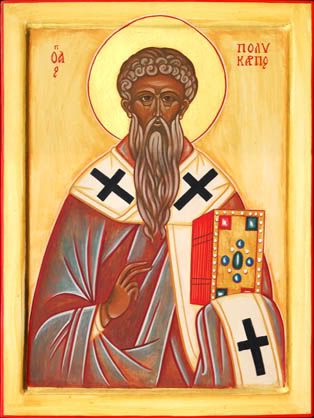
69 - 155
Martyr
Associate of, converted by, and disciple of Saint John the Apostle. Friend of Saint Ignatius of Antioch. Fought Gnosticism. Bishop of Smyrna (modern Izmir, Turkey). Revered Christian leader during the first half of the second century. The Asia Minor Churches recognized Polycarp's leadership and chose him representative to Pope Anicetus on the question the date of the Easter celebration. Only one of the many letters written by Polycarp has been preserved, the one he wrote to the Church of Philippi, Macedonia. At 86, Polycarp was to be burned alive in a stadium in Smyrna; the flames did not harm him and he was finally killed by a dagger, and his body burned. The "Acts" of Polycarp's martyrdom are the earliest preserved, fully reliable account of a Christian martyr's death.
"Stand fast, therefore, in this conduct and follow the example of the Lord, 'firm and unchangeable in faith, lovers of the brotherhood, loving each other, united in truth,' helping each other with the mildness of the Lord, despising no man." (Polycarp, Letter to the Philippians)
...
When the pyre was ready, Polycarp took off all his outer clothes and loosened his under-garments. There and then he was surrounded by the material for the pyre. Whey they tried to fasten him also with nails, he said, "Leave me as I am. The one who gives me the strength to endure the fire will also give me strength to stay quite still on the pyre, even without the precaution of your nails." So they did not fix him to the pyre with nails, but only fastened him instead.
Looking up to heave, he said, "Lord, almighty God, Father of your beloved and blessed Son Jesus Christ, through whom have come to the knowledge of yourself, God of angels, of powers, of all creation, of all the race of saints who live in your sight, I bless you for judging me worthy of this day, this hour, so that in the company of the martyrs I may share the cup of Christ, your anointed one, and so rise again to eternal life in soul and body through the power of the Holy Spirit.
"I praise you for all things, I bless you, I glorify you through the eternal priest of heaven, Jesus Christ, your beloved Son. Through him by glory to you, together with him and the Holy Spirit, now and for ever. Amen."
When he had said, "Amen" and finished the prayer, the officials at the pyre lit it. But, when a great flame burst out, those of us privileged to see it witnessed a strange and wonderful thing. Like a ship's sail swelling in the wind, the flame became as it were a dome encircling the martyr's body. Surrounded by the fire, his body was like bread that is baked, or gold and silver white-hot in a furnace, not like flesh that has been burnt. So sweet a fragrance came to us that it was like that of burning incense or some other costly and sweet-smelling gum.
from a letter by the Church of Smyrna on the martyrdom of Saint Polycarp
From Catholic Forum.
Sunday, February 20, 2005
I picked Veronica
As a confirmation name, I mean. So I will be Margaret Patricia Veronica, like Betsy is Elizabeth Patricia Mary :)
There have been two St. Veronicas:
St Veronica, who had the famous "Veronica's Veil" - she wiped the face of Christ during His Passion, which left an imprint of the Holy Face on the cloth;
and St. Veronica Giuliani (1660-1727)
There have been two St. Veronicas:
St Veronica, who had the famous "Veronica's Veil" - she wiped the face of Christ during His Passion, which left an imprint of the Holy Face on the cloth;
and St. Veronica Giuliani (1660-1727)
From CIN.She was born in 1660 at Mercatello in Urbino and became a Capuchiness at Città di Castello when she was only seventeen. Because the bishop who confirmed her had prophesied that she would one day become a saint, she was given a hard novitiate which was further complicated by illness.
In 1694, the crown of thorns was imprinted upon her forehead and in 1697 she received the stigmata; but what is most remarkable is that towards the end of her life she seems to have had an accurate mental picture of the physical constitution of her heart. She even drew a chart on which she indicated the position in the heart of the several emblems of our Lord's passion: a cross, a chalice, a crown of thorns, three nails and seven swords. On her death, the heart was examined by two professors of medicine and surgery before a committee of notable ecclesiastics, and a formal testimony was made that a number of minute objects corresponding to those shown in St. Veronica's plan were to be found in the right ventricle.
Saturday, February 19, 2005
Friday, February 18, 2005
Fascinating
Lyndsey sent me this article :) It is especially appropriate since Jenn was just asking yesterday if any of us believed in the Devil!
ROME -- In a classroom ringed by Rome's pine-covered hills, 100 priests solemnly stood in prayer, made the sign of the cross and got down to business: a lesson on Satanism, demonic possession and exorcism.Read all of it.
Worried about ritual killings in Italy and simple adolescent angst, a Vatican-recognized university launched the course Thursday to help priests and seminarians understand what makes people turn to the occult. The class is billed as the first of its kind, with wide-ranging instruction by exorcists, psychologists and a police criminologist.
The Pontifical Academy "Regina Apostolorum" wants to clear up misconceptions -- especially about exorcisms, a practice most priests do not carry out ...
... Priests must never be proud of their ability, remembering that they are merely conduits of Christ, he said. They must not perform exorcisms on people they suspect have psychological problems. And they should not get carried away and invent mystical gestures.
"Everything must be carried out in extreme sobriety," cautioned Nanni, an exorcist himself. Among the few acceptable tools are a crucifix and prayer.
In shop talk at the end of class, one priest admitted that in his decades of performing exorcisms, he was not always sure he was doing it right. Another asked if seances, for example, could leave people vulnerable to psychological problems.
"All contact with the occult and the esoteric is extremely dangerous," Nanni told the sea of priests in black jackets and white collars ...
... The class at the academy -- run by the Legionaries of Christ, a conservative order -- drew both Italians and foreigners. Rev. Christopher Barak, who came from the Lincoln, Neb., area at his bishop's request, senses a renewed concern about the devil among Roman Catholics.
"In the '60s and '70s, people got away from that," Barak said. "Even theologians said, 'No, the devil is just a myth."'
The course ends in April with the culminating lesson: "Testimony of an Exorcist." Two of Italy's some 400 exorcists are to tell their stories.
Widely accepted signs of possession -- some of which were depicted in the 1973 movie, "The Exorcist" -- include speaking in unknown tongues and demonstrating physical force beyond one's natural capacity. In 1999, when the Vatican issued its first new guidelines since 1614 for driving out devils, it urged priests to take modern psychiatry into account in deciding who should be exorcised.
The updated exorcism rite, contained in a red, leather-bound book, was a reflection of Pope John Paul II's efforts to convince the skeptical that the devil is very much in the world. At the time, he gave a series of homilies denouncing the devil as a "cosmic liar and murderer."
A former papal aide, the late Cardinal Jacques Martin, wrote in his memoirs that John Paul performed the exorcism rite in 1982, on an Italian woman who was screaming and writhing.
Thursday, February 17, 2005
What an interesting lecture
Today in Sociology we were discussing poverty and social stratification. The professor, who hates pink as a "stereotypically feminine" color yet seems to wear it on a not infrequent basis, asked us what could be done to solve the poverty problem. Oh boy, I thought to myself, because I already knew what the answers would include.
"All these poor people! Icky, icky, swarms of them! They make us so uncomfortable, because they make us ashamed of our greed and materialism and remind us that we have a duty to care about people besides ourselves! There are so many of them, and they need all those resources we want for ourselves. Like money, which we just have to have tons of ... To buy things with. Why, just this year, the government had to help a woman in the inner city put food in her children's mouths, when Uncle Sam could have been doing something worthwhile like buying my husband's Viagra! What is government for, if not to guarantee a satisfying sex life? But there these crowds of poor people are, demanding things like food and shelter. So, so unnerving. What to do about this rabble? I know! Sterilize them! Pour birth control down their throats! If they do conceive, abort their brats before they're born! A Planned Parenthood in every slum!"
That was pretty much the gist, although obviously no one was so crass as to put it in those words. The reason I could predict the response so well was because the mantra is always the same: Just enough of us rich, white, sleek and successful people. Too many of you poor, minority, sickly, suffering people.
We don't want to spend what's ours to help you ... So let's figure out how to make you go away.
"All these poor people! Icky, icky, swarms of them! They make us so uncomfortable, because they make us ashamed of our greed and materialism and remind us that we have a duty to care about people besides ourselves! There are so many of them, and they need all those resources we want for ourselves. Like money, which we just have to have tons of ... To buy things with. Why, just this year, the government had to help a woman in the inner city put food in her children's mouths, when Uncle Sam could have been doing something worthwhile like buying my husband's Viagra! What is government for, if not to guarantee a satisfying sex life? But there these crowds of poor people are, demanding things like food and shelter. So, so unnerving. What to do about this rabble? I know! Sterilize them! Pour birth control down their throats! If they do conceive, abort their brats before they're born! A Planned Parenthood in every slum!"
That was pretty much the gist, although obviously no one was so crass as to put it in those words. The reason I could predict the response so well was because the mantra is always the same: Just enough of us rich, white, sleek and successful people. Too many of you poor, minority, sickly, suffering people.
We don't want to spend what's ours to help you ... So let's figure out how to make you go away.
Wednesday, February 16, 2005
Bonfire of the Class Schedules
LOL, just kidding. Although I always felt Savonarola got a bad rap. And not just in his own day with the burning at the stake matter ... argh.
This is my schedule so far - I managed to get all the classes I "want." By "want" I wish you to infer that I have the same degree of enthusiasm for this as a victim of cardiac arrest who "wants" surgery, asap.
IART 117 A01
INTRO TO FINE ARTS - MW, 8-10
JOUR 233 A04
INFO GATHERING - TThTh, 10-11, 11-1
PSY 101 A03
GENERAL PSY - MTWThF, 1-2
COMS 103 A16
PUBLIC SPEAKING - TTh, 2-4
I ALMOST managed to have no Friday classes. ALMOST. ::: cries ::: that awful psych class ... oh well, it's a 101. If I wanna skip and go on home, who can stop me? Bwaaaa, ha ha.
This is my schedule so far - I managed to get all the classes I "want." By "want" I wish you to infer that I have the same degree of enthusiasm for this as a victim of cardiac arrest who "wants" surgery, asap.
IART 117 A01
INTRO TO FINE ARTS - MW, 8-10
JOUR 233 A04
INFO GATHERING - TThTh, 10-11, 11-1
PSY 101 A03
GENERAL PSY - MTWThF, 1-2
COMS 103 A16
PUBLIC SPEAKING - TTh, 2-4
I ALMOST managed to have no Friday classes. ALMOST. ::: cries ::: that awful psych class ... oh well, it's a 101. If I wanna skip and go on home, who can stop me? Bwaaaa, ha ha.
Tuesday, February 15, 2005
Monday, February 14, 2005
Whooosh
That's the noise my newly short hair made today as Frizz Weather returned. Ahhhh. Today was a pretty good day, although it started off in a nasty manner with me finding out I have an Economics test on Thursday. I shoulda guessed.
However, in my Northern Renaissance shoot-me-now-before-it-kills-me class, I got a "Well done, A-" on that horrible midterm I pretty much hanged myself writing. An A. No wait, an A MINUS. You're real cute, aren't you, Dr. Bebb. I was preparing myself for much worse, since he took pains to set the mood before he passed them back. "All of you passed ("oh great! A D!" I thought to myself) but some of you didn't understand how to use the material. Some of you have 'see me' written on your papers." This was my stomach's cue to drop to my heels. Oh, the humanity.
Two weeks until twelve page Thomas More thing is due. Ohhhhh. Must stop procrastinating, took all weekend to write eight pages on two different topics for the mid-term, will take all of these two weeks to B.S. twelve pages out of essentially two pages of material ... argh ... When I schedule Spring quarter classes on Wednesday, I am going to be so much nicer to myself. Except for that :: Sob :: info-gathering class.
However, in my Northern Renaissance shoot-me-now-before-it-kills-me class, I got a "Well done, A-" on that horrible midterm I pretty much hanged myself writing. An A. No wait, an A MINUS. You're real cute, aren't you, Dr. Bebb. I was preparing myself for much worse, since he took pains to set the mood before he passed them back. "All of you passed ("oh great! A D!" I thought to myself) but some of you didn't understand how to use the material. Some of you have 'see me' written on your papers." This was my stomach's cue to drop to my heels. Oh, the humanity.
Two weeks until twelve page Thomas More thing is due. Ohhhhh. Must stop procrastinating, took all weekend to write eight pages on two different topics for the mid-term, will take all of these two weeks to B.S. twelve pages out of essentially two pages of material ... argh ... When I schedule Spring quarter classes on Wednesday, I am going to be so much nicer to myself. Except for that :: Sob :: info-gathering class.
Sunday, February 13, 2005
Saturday, February 12, 2005
Snip snip snip
Well, ladies and gentlemen, I got my hair cut. Lyndsey and I went to Regis Hair Salon uptown on Friday and we both got trims. I told the lady who did my hair that I did not want layers, but she sort of ... argued with me. And gave me layers anyway.
It is way too short for my taste, but oh well. It will grow out. It is less "poofy" now, at least :)
Lyndsey's hair looked suuuuuper, of course! She said mine looked good, but I dunno. Maybe she was JUST SAYING THAT! ;)
It is way too short for my taste, but oh well. It will grow out. It is less "poofy" now, at least :)
Lyndsey's hair looked suuuuuper, of course! She said mine looked good, but I dunno. Maybe she was JUST SAYING THAT! ;)
Saint of the Week
Who else? St. Valentine :)
ST. VALENTINE
MARTYR
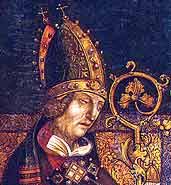
A.D. 269
Patron of the Betrothed,
Lovers, and Happy Marriages
Got it here.
See also this article from The Catholic Leader.
ST. VALENTINE
MARTYR
A.D. 269
Patron of the Betrothed,
Lovers, and Happy Marriages
In the city of Rome there once lived an emperor named Claudius. He is known in history as Claudius the Cruel.
Near his palace was a beautiful temple where served the priest Valentine. The Romans loved him dearly and assembled into the temple to hear his words. Before the fire that always burned on the altar they knelt to ask his blessing. Rich and poor, wise and ignorant, old and young, noble and common people they all flocked to Valentine.
In the Roman empire wars broke out. Claudius summoned the citizens forth to battle and year after year the fighting continued. Many of the Romans were unwilling to go. The married men did not want to leave their families. The younger men did not wish to leave their sweethearts. The emperor was angry when soldiers were too few. He ordered that no marriages should be celebrated and that all engagements must be broken off immediately.
Many a young Roman went off to the wars in sorrow, leaving his love. Many a Roman maiden died of grief as a result of this decree.
Now the good priest Valentine heard of the emperor's command and was very sad. When a young couple came to the temple, he secretly united them in marriage in front of the sacred altar. Another pair sought his aid and in secret he wedded them. Others came and quietly were married. Valentine was the friend of lovers in every district of Rome.
But, such secrets could not be kept for long. At last word of Valentine's acts reached the palace and Claudius the Cruel was angry, exceedingly angry. He summoned his soldiers. "Go! Take that priest in the temple! Cast him into a dungeon! No man in Rome, priest or not, shall disobey my commands!"
Valentine was dragged from the temple, dragged away from the altar where a young maiden and a Roman youth stood, ready to wed. Off to prison the soldiers took him.
All of Valentine's friends as well as their friends, interceded with Claudius in vane. Well was he named Claudius the Cruel. In a dungeon Valentine languished and died. His devoted friends buried him in the church of St. Praxedes. When you go to Rome you can see the very place. It was the year 270, on the fourteenth of February.
Another story says that Valentine was one of the early Christians in those far-away days when that meant danger and death. For helping some Christian martyrs he was seized, dragged before the prefect of Rome and cast into jail. There he cured the keeper's daughter of blindness. When the cruel emperor learned of this miracle he gave orders that Valentine should be beheaded. The morning of the execution, he is said to have sent the keeper's daughter a farewell message signed, "From your Valentine."
Long years before 270, when Rome was first founded it was surrounded by a wilderness. Great packs of wolves roamed over the countryside. Among their many gods the Romans had one named Lupercus who watched over the shepherds and their flocks. In his honor they held a great feast in February of each year and called it the Lupercalia. The Lupercalia festival was an echo of the days when Rome consisted of a group of shepherd folk that lived on a hill now know as Palantine. On the calendar used back in those days, February came later than it does today, so Lupercalia was a spring festival.
Some believe the festival honored Faunus, who like the Greek Pan, was a god of herds and crops, But the origin of Lupercalia is so ancient that even scholars of the last century before Christ were never sure.
There is no question about its importance. Records show, for instance, that Mark Antony, an important Roman, was master of the Luperci College of Priests. He chose the Lupercalia festival of the year 44 B.C. as the proper time for offering the crown to Julius Caesar.
Each year, on February 15, the Luperci priests gathered on the Palantine at the cave of Lupercal. Here, according to legend, Romulus and Remus, founders of Rome, had been nursed by a mother wolf. In Latin, the word lupus is the word for wolf.
Some of the rituals involved youths of noble birth to run through the streets with goatskin thongs. Young women would crowd the street in the hope of lashing the sacred thongs as it was believed to make them better able to bear children. The goatskin thongs were known as the februa and the lashing the februatio, both coming from a Latin word meaning to purify. The name of the month February come from this meaning.
Long after Rome became a walled city and the seat of a powerful empire, the Lupercalia lived on. When Roman armies invaded what is now France and Britain in the first century before Christ, they took the Lupercalia customs there. One of these is believed to be a lottery where the names of Roman maidens were placed in a box and drawn out by the young men. The girl whose name he drew each man accepted as his love - for a year or longer.
After Christianity was firmly established the priests wanted the people to forget the old heathen gods. But they did not wish to do away with all their feasts and sports. So they kept the Lupercalia and called it Valentine's day.
During the medieval days of chivalry, the names of English maidens and bachelors were put into the box and drawn out in pairs. Each couple exchanged gifts. The girl became the man's valentine for that year. On his sleeve he wore her name and it was his bounded duty to attend and protect her.
This old, old custom of drawing names on the fourteenth of February was considered a good omen for love. It often foretold a wedding. For since the beginning of things this has been lovers' day, a time for loving, for giving and receiving love tokens.
History tells us the first modern valentines date from the early years of the fifteenth century. The young French duke of Orleans, captured at the battle of Agincourt, was kept a prisoner in the Tower of London for many years. To his wife he wrote poem after poem, real valentines. About sixty of them remain. These can be seen among the royal papers in the British Museum.
Flowers as valentines appear nearly two hundred years later. A daughter of Henry IV of France gave a party in honor of St. Valentine. Each lady received a beautiful bouquet of flowers from the man chosen as her valentine.
Thus from Italy and France and England has come the pretty custom of sending our friends loving messages on this day. With flowers, with heart-shaped candies, with lacy valentines whose frills and furbelows hide the initials of the sender we honor the good priest who disobeyed Claudius the Cruel.
Got it here.
See also this article from The Catholic Leader.
Friday, February 11, 2005
Lovely little meditation
Jesus set the book of nature before me and I saw that all the flowers He has created are lovely. The splendor of the rose and the whiteness of the lily do not rob the little violet of its scent nor the daisy of its simple charm. I realized that if every tiny flower wanted to be a rose, spring would lose its loveliness and there would be no wildflowers to make the meadows gay.
It is just the same in the world of souls - which is the garden of Jesus. He has created the great saints who are like the lilies and the roses, but He has also created much lesser saints and they must be content to be the daisies or the violets which rejoice His eyes whenever He glances down. Perfection consists in doing His will, in being that which He wants us to be.
Jesus, help me to simplify my life by learning what you want me to be - and becoming that person.
From Story of a Soul, by St. Therese of Lisieux.
Thursday, February 10, 2005
Moooood swiiiiing
I have been having odd mood swings today. I was bound and determined to get a hold of Fr. Ference, come hell or high water. (Hell or high water = Cliche! Says my Newswriting prof. Forbidden! Ten points off!) So I woke up at nine and started calling St. Mary's. I kept getting his machine. Finally I called the parish office itself, and the lady (I think it was a lady although it sounded suspiciously like a man) told me to just leave a message on the machine and she would remind Fr. Damian there were messages. He finally got back to me around 12:30. Betsy, confirmation is at 4 o'clock on April 2. You must come and be my sponsor or I will diieeee. Or something.
Getting that done was the "up" part of the mood swing. I also went to see my journalism advisor today to get my DARS report, - for my non-OU readers, that would be a computer report that tells you how far along you are in requirements for your major - and that was the "down" part. She wasn't very friendly, for some reason, and I am going to have to take info-gathering next quarter. Lauren, is that a hard class? Everything I have heard points to yes. And I was gonna give myself a break next quarter, too, :(
When I got back to the dorm, I had to struggle for about ninety minutes with my umbrella, which has joined the local union and now refuses to open and close without intense negotiation with management. In the process, I dropped my notebook and my DARS report into the lake, I mean, puddle, forming outside the back door of Lincoln Hall. My hair was in Full Frizz Mode, I hadn't showered yet, and I had pretty much had it. SNOW, Athens weather idiots, predict SNOW without ICE and I will love you forever and adopt your cats when you die.
He he, so they had pancakes in the dining hall Tuesday night, I hear. What you may not know (time for the Paul Harvey "Rest of the Story" schtick) is that eating pancakes on Shrove Tuesday - also known as Mardi Gras and Fat Tuesday - is a traditional custom for preparing for Ash Wednesday and Lent! People make pancakes on Tuesday because they contain fat, butter, and other foods forbidden during the penitential season, and you gotta use 'em up. See link here. Har! Seeeee, even secular universities and students celebrate Lent the Catholic way, without even knowing it! :)
Getting that done was the "up" part of the mood swing. I also went to see my journalism advisor today to get my DARS report, - for my non-OU readers, that would be a computer report that tells you how far along you are in requirements for your major - and that was the "down" part. She wasn't very friendly, for some reason, and I am going to have to take info-gathering next quarter. Lauren, is that a hard class? Everything I have heard points to yes. And I was gonna give myself a break next quarter, too, :(
When I got back to the dorm, I had to struggle for about ninety minutes with my umbrella, which has joined the local union and now refuses to open and close without intense negotiation with management. In the process, I dropped my notebook and my DARS report into the lake, I mean, puddle, forming outside the back door of Lincoln Hall. My hair was in Full Frizz Mode, I hadn't showered yet, and I had pretty much had it. SNOW, Athens weather idiots, predict SNOW without ICE and I will love you forever and adopt your cats when you die.
He he, so they had pancakes in the dining hall Tuesday night, I hear. What you may not know (time for the Paul Harvey "Rest of the Story" schtick) is that eating pancakes on Shrove Tuesday - also known as Mardi Gras and Fat Tuesday - is a traditional custom for preparing for Ash Wednesday and Lent! People make pancakes on Tuesday because they contain fat, butter, and other foods forbidden during the penitential season, and you gotta use 'em up. See link here. Har! Seeeee, even secular universities and students celebrate Lent the Catholic way, without even knowing it! :)
Wednesday, February 09, 2005
Cutest thing ever
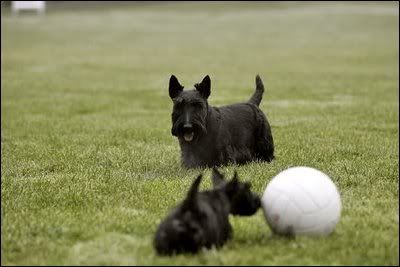
(CBS) She's finally at the White House. Miss Beazley, the Scottish Terrier puppy, has joined the first family. Miss Beazley was a birthday gift from the president to the first lady. Now she's ten-weeks old old and ready for her close-up.Rest of story.
"Here's our new little baby, Miss Beazley," Laura Bush said while introducing her to the press, on the South Lawn of the White House. "Isn't she the cutest?"
But what about –- the other Bush dog -- Barney? Till now, he's been the star of the show, and he wasn't quite sure what to make of this new creature moving in on his turf.
Tuesday, February 08, 2005
Recovering Pope to Remain in Hospital
From CWNews.com:
Read the rest.
Vatican, Feb. 07 (CWNews.com) - Pope John Paul II (bio - news) no longer has a fever, and a Vatican bulletin on February 7 indicated that his recovery was continuing without incident, but he will remain in the Gemelli Hospital for several more days "for obvious precautionary reasons."
In his Monday statement on the Pope's condition, Vatican spokesman Joaquin Navarro-Valls said that the Holy Father is "eating regularly and sat in an armchair for a few hours." He added that the Pontiff is concelebrating Mass-- presumably from his bed-- each day.
Despite his illness, John Paul II has evidently retained his self-deprecating sense of humor. Navarro-Valls told reporters that the Pope is reading the newspapers regularly; he said that the Pontiff wanted to see "how my illness is going."
Read the rest.
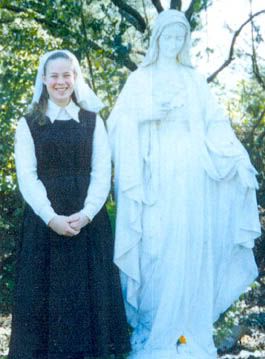
The veil and "habit" worn by a girl
who has just entered the cloister
From Photo Journey of a Poor Clare Nun
Maybe this bit best explains why someone would want to become a nun :) :
When the solemn announcement of the date of her investiture is made by Mother Abbess, her joy is complete for now she prepares to become the fiancée of Our Lord and King. The fire is stoked and her heart is inflamed with the burning desire to give up everything for the One Whom she loves. On the day of her investiture, she takes off the snow-white festive gown she has worn to greet her King and is clothed by Mother Abbess with the rough-brown garments of the lowly. With joy she lets her long silky hair be cut and the novice-white veil be placed upon her head. She kicks off her white satin shoes to walk barefoot in the way of the Lord. Embracing the crucifix which is handed to her, she is now a Poor Clare and is given a new name signifying her new life.
Monday, February 07, 2005
Scary stuff from "Inside the Vatican" Magazine
:::Worries::: Please pray for the Pope.
Link here and here.
It goes on here.
Link here and here.
"Ten Minutes Later, He would Have Been Gone"
The Pope's condition was grave on the evening he was taken to the hospital. Here follows our reconstruction of the events
- by Inside the Vatican staff
February 5, 2005
At about 7 p.m. on Tuesday evening, February 1, the chop of helicopter blades began to cut through the still evening air above Vatican City. It was an Italian police helicopter, equipped with special infra-red heat-sensors to pick up traffic jams in Rome's streets, or to closely track a speeding vehicle in the night.
The helicopter wheeled in a tight circle not far from the dome of St. Peter's, then followed the streets along the Vatican's high walls toward the "Agostino Gemelli" hospital, about two and a half miles from St. Peter's Square.
At about 7:30 p.m., from the Gemelli's internal heliport, another helicopter lifted off and sped rapidly toward Vatican City. Within moments, it was landing on the helicopter pad in the Vatican gardens, not far from the back wall of St. Peter's Basilica, at the very heart of the world's smallest state.
An Italian doctor, Prof. Dogliani, an expert in cardiovascular medicine, hastened from the helicopter pad toward the Apostolic Palace, where for some 500 years the bishops of Rome have had their residence. The Swiss Guards, advised of his coming, allowed him to enter. Millions of Italians heard these details on the evening of February 2, on the Italian television program "Porta a Porta" ["Door to Door"] from Giuseppe De Carli, the "vaticanista" of the most important Italian television news channel, TG1. De Carli was continually on the air informing Italians and the world about the Pope's illness and hospitalization. On the topmost floor of the Vatical palace where John Paul II has his private apartment, the Holy Father was having trouble breathing. His throat was inflamed and constricted due to a bout with the flu.
With the Pope was his most trusted advisor, Bishop Stanislaw Dziwisz, 65, John Paul's personal secretary since 1965, since the days when John Paul was bishop of Krakow, Poland, and "don Stanislaw" was one of the fastest skiers on the slopes of the Tatra mountains in southern Poland, where he and John Paul first met.
Dziwisz, widely regarded as one of the most powerful men in the Vatican today because of his role at the Pope's side, suggested to John Paul that it might be a good idea to go to the hospital to have his breathing checked. The Pope, 84 years old, rejected the suggestion, decisively shaking his head.
He felt, evidently, that his situation was not serious enough to require hospitalization. He indicated that he wanted dinner served. Medical experts in Rome report that part of the Pope's breathing problem is due to his curved posture and general lack of mobility for a number of years. He has difficulty breathing because his lung cavity is under pressure, according to doctors.
At about 8 p.m., the Pope and Dziwisz sat down for a light dinner. Some minutes passed quietly.
Then, his inflamed throat irritated by eating he suddenly coughed and had difficulty swallowing. Soon, the Pope was gasping for breath. "The Pope had a strong feeling that he was suffocating," the veteran Vatican journalist Marco Tosatti would explain in "La Stampa" of Turin on February 3.
Soon, however, normalcy returned and the Pope could breathe again. But Dziwisz by then had summoned Doctor Renato Buzzonetti, the Pope's long-time personal physician.
Buzzonetti, too, urged the Pope to leave the Vatican and go to the hospital. The Pope still refused. He did not consider his condition that serious. An hour passed. An hour and a half. Two hours...
Then, another coughing spell in which the Pope sensed he could not breathe. At last, the Pope himself was worried. He yielded.
It goes on here.
Sunday, February 06, 2005
At laaast
Well, the Weekend from Hell is over. I finished my History mid-term papers; the second paper didn't take as long as the first. I ended up writing four and a half pages for each one, instead of the three and a half I expected.
My priest was on vacation this weekend, and we had a visiting priest who was pretty bad. He was very theatrical; everything was done with a flourish and with dramatic pauses. His homily went on for a tremendous amount of time in its unending search for a point. He also altered and added a lot of words to the liturgy, including the infamous "The celebration is over, let us go now to serve God and one another" with dramatic pauses, of course. We said the Apostle's Creed instead of the Nicene Creed. Surely that's not something done specially for Lent? Which hasn't even started yet, after all. And he left out the line about believing in "the forgiveness of sins." Maybe that part was just a matter of his eye skipping over the line. ::: Tries really hard to give him the benefit of the doubt, even though the Apostle's Creed is a prayer even little kids can lisp by heart :::
He was quite charismatic and seemed very friendly, however. A nice guy, but he needs to get it together a bit better. You could feel that the congregation was disconcerted when he changed the words; our parish priest sticks to the program. In particular the bit about the Creed caused confusion; everyone was paging through the missal trying to figure out what was going on. Ahk. I give him a 5 on the Heterodoxy Scale, a marvelous system of my own invention with 0 being the Pope and 10 being Call to Action type people ;)
My priest was on vacation this weekend, and we had a visiting priest who was pretty bad. He was very theatrical; everything was done with a flourish and with dramatic pauses. His homily went on for a tremendous amount of time in its unending search for a point. He also altered and added a lot of words to the liturgy, including the infamous "The celebration is over, let us go now to serve God and one another" with dramatic pauses, of course. We said the Apostle's Creed instead of the Nicene Creed. Surely that's not something done specially for Lent? Which hasn't even started yet, after all. And he left out the line about believing in "the forgiveness of sins." Maybe that part was just a matter of his eye skipping over the line. ::: Tries really hard to give him the benefit of the doubt, even though the Apostle's Creed is a prayer even little kids can lisp by heart :::
He was quite charismatic and seemed very friendly, however. A nice guy, but he needs to get it together a bit better. You could feel that the congregation was disconcerted when he changed the words; our parish priest sticks to the program. In particular the bit about the Creed caused confusion; everyone was paging through the missal trying to figure out what was going on. Ahk. I give him a 5 on the Heterodoxy Scale, a marvelous system of my own invention with 0 being the Pope and 10 being Call to Action type people ;)
Saturday, February 05, 2005
Auuuugh
I just spent ten ... count them, ten! hours writing one of my two essay questions. I feel like cooked pasta. I am probably equally fattening.
Yum, carbs!
Tomorrow will be more of the same.
::: Dies :::
Yum, carbs!
Tomorrow will be more of the same.
::: Dies :::
Indulgences for the Year of the Eucharist
The Holy Father declared the Year of the Eucharist in October 2004, to last until 2005. Anyone who likes can come with me on Satuday night and spend an hour in adoration before the Blessed Sacrament. It's nice and quiet and nobody bothers you :)
From EWTN.
The Decree on the Indulgence for the Year of the Eucharist
Apostolic Penitentiary:
URBIS ET ORBIS DECRETUM
The gift of an Indulgence during the 'Year of the Eucharist' is attahced to particular acts of worship and veneration of the Most Blessed Sacrament
The greatest of the miracles (cf. Solemnity of the Body and Blood of Christ, Office of Readings, Second Reading) and supreme memorial of the Redemption which Our Lord Jesus Christ brought about through his Blood, the Eucharist, as sacrifice and sacrament, faultlessly produces the unity of the Church, sustains her with the power of supernatural grace, bathes her in ineffable joy and provides supernatural assistance to nourish the piety of the faithful and impel them to intensify and indeed to perfect their Christian life.
In consideration of this, moved by concern for the Church and to encourage both public and private devotion to the Most Blessed Sacrament, the Supreme Pontiff John Paul II decreed in his Apostolic Letter Mane Nobiscum Domine of 7 October 2004 that a special "Year" be celebrated throughout the Church, to be called the "Year of the Eucharist".
Furthermore, to encourage in the faithful throughout this year a deeper knowledge and more intense love for the ineffable "Mystery of Faith" and for them to obtain an ever greater abundance of spiritual fruit, at the Audience the Holy Father granted to the undersigned Moderators of the Apostolic Penitentiary last 17 December, the Holy Father himself desired to endow with indulgences certain specific acts of worship and devotion to the Most Blessed Sacrament, as follows:
1. A Plenary Indulgence is granted to each and every member of the faithful under the usual conditions (sacramental Confession, Eucharistic Communion and prayers for the Supreme Pontiff's intentions, in a spirit of total detachment from any inclination to sin), every time they take part, taking care to do so with pious attention, in a sacred liturgy or pious practice in honour of the Most Blessed Sacrament, solemnly exposed or preserved in the tabernacle.
2. A Plenary Indulgence is also granted to the clergy, members of Institutes of Consecrated Life and Societies of Apostolic Life and to the other faithful bound by law to recite the Liturgy of the Hours, as well as those who are accustomed to praying the Divine Office for pure devotion, every time, at the end of the day, when they recite Vespers and Compline before the Lord present in the tabernacle, either in community or privately.
...
Priests who carry out a pastoral ministry, especially parish priests, keeping in mind the "Suggestions and Proposals" indicated by the Congregation for Divine Worship and the Discipline of the Sacraments on 15 October 2004, should inform their faithful in the most appropriate way of this beneficial disposition of the Church; such priests should be ready and available to hear their confessions and, on days to be determined as "convenient" for the faithful, should solemnly lead public recitations of prayers to Jesus in the Eucharist.
Finally, in imparting catechesis, let them urge the faithful to give frequent open testimonies of faith and veneration to the Most Blessed Sacrament as is proposed in the General Concession IV of Enchiridion Indulgentiarium, and also to be aware of the other concessions of the same Enchiridion: n. 7, Adoration and Eucharistic procession; n. 8, Eucharistic and spiritual Communion; n. 27, First Mass of newly ordained priests and jubilee celebrations of priestly and episcopal Ordinations.
This Decree comes into force during the "Year of the Eucharist" from the day on which it is published in L'Osservatore Romano, contrary dispositions notwithstanding.
From the Offices of the Apostolic Penitentiary, Rome, 25 December 2004, on the Solemnity of the Nativity of Our Lord Jesus Christ.
Cardinal James Francis Stafford
Major Penitentiary
Gianfranco Girotti, O.F.M. Conv.
Regent
From EWTN.
Friday, February 04, 2005
Ah, Success Numero 2
I got a 97% on this "obituary" in my Newswriting class. The professor actually read it out loud in class for the other students. It was humiliating because she grabbed it right out of my hands, so it wasn't anonymous or anything. It was held up as an example of a good obit, which of course is nice, but she also pointed out all my embarrassing mistakes - like I spelled dessert, "desert." It screams unprofessional :/
I wonder if there actually is a Terrance C. Austin in Athens. I hope not. If there is ... If you're not dead, well, sorry! ;)
I wonder if there actually is a Terrance C. Austin in Athens. I hope not. If there is ... If you're not dead, well, sorry! ;)
ATHENS, Ohio Jan. 24 - Terrance C. Austin of 418 Cottage Hill Road, a war hero and retired chef who for years delighted diners, family and friends with his culinary creations died of throat cancer last Sunday at Mercy Hospital. He was 81.
He first learned to cook as a child at his mother's knee, and was trained as a cook in the marines. However, in Korea, Mr. Austin was transferred to rifleman, winning two purple hearts and a bronze star in that capacity.
After returning home, Mr. Austin worked as a chef at Deacosti's Restaurant for more than 25 years. Following his retirement from Deacosti's, where he had acquired a reputation for making excellent deserts, Mr. Austin teamed up with his wife to cater for weddings and social gatherings, and continued to cook for family gatherings and holidays. "Dad loved to cook, and he loved working with people," his son Walter said. "As soon as we stepped in the door we'd smell the hams, turkeys, greens, and baked pies."
Mr. Austin was born on December 27, 1924, in Chicago. A member of St. Mark African Methodist Episcopal church, where he sang in the choir, he is survived by Anna Austin, his wife of 56 years, five children and 14 grandchildren. Since moving to Athens as an infant, Mr. Austin had been a life-long resident of the area, except for the three years he spent in military service.
Ohhh
This weekend is going to be horrible. I have no time to do anything but work work work, stop to breathe, work work work some more!! However, this does not prevent me from procrastinating at Albinoblacksheep.com.
Behold! Amusing thingy! "Come to Norway, because it's better than Kenya!"
Behold! Amusing thingy! "Come to Norway, because it's better than Kenya!"
Thursday, February 03, 2005
Saint of the Week
Hmmm, so she was a twin, too! ;)
ST. SCHOLASTICA
480 - 542
Feastday: February 10
Patroness of nuns, children with convulsions,
invoked against storms
From For All the Saints.
480 - 542
Feastday: February 10
Patroness of nuns, children with convulsions,
invoked against storms
Born in Nursia (Nurcia), Italy, c. 480 (?); died near Monte Cassino, Italy, c. 543. Almost everything we know about Saint Scholastica comes from the Dialogues of Saint Gregory the Great.
Saint Scholastica, twin sister of Saint Benedict of Nursia who founded of the Benedictine order, was consecrated to God at a very early age but probably continued to live in her parents' home. It is said that she was as devoted to Jesus as she was to her brother. So, when Benedict established his monastery at Monte Cassino, Scholastica founded a convent in nearby Plombariola, about five miles south of Monte Cassino. The convent is said to have been under the direction of her brother, thus she is regarded as the first Benedictine nun.
The siblings were quite close. The respective rules of their houses proscribed either entering the other's monastery. According to Saint Gregory, they met once a year at a house near Monte Cassino monastery to confer on spiritual matters, and were eventually buried together, probably in the same grave. Saint Gregory says, "so death did not separate the bodies of these two, whose minds had ever been united in the Lord."
Saint Gregory tells the charming story of the last meeting of the two saints on earth. Scholastica and Benedict had spent the day in the "mutual comfort of heavenly talk" and with nightfall approaching, Benedict prepared to leave. Scholastica, having a presentiment that it would be their last opportunity to see each other alive, asked him to spend the evening in conversation. Benedict sternly refused because he did not wish to break his own rule by spending a night away from Monte Cassino. Thereupon, Scholastica cried openly, laid her head upon the table, and prayed that God would intercede for her. As she did so, a sudden storm arose. The violent rain and hail came in such a torrential downpour that Benedict and his companions were unable to depart.
"May Almighty God forgive you, sister" said Benedict, "for what you have done."
"I asked a favor of you," Scholastica replied simply, "and you refused it. I asked it of God, and He has granted it!"
Just after his return to Monte Cassino, Benedict saw a vision of Scholastica's soul departing her body, ascending to heaven in the form of a dove. She died three days after their last meeting. He placed her body in the tomb he had prepared for himself, and arranged for his own to be placed there after his death. Her relics were alleged by the monk Adrevald to have been translated (July 11) to a rich silver shrine in Saint Peter's Church in Le Mans, France, which may have been when Benedict's were moved to Fleury. In 1562, this shrine was preserved from the Huguenots' plundering.
Some say that we should only petition God for momentously important matters. God's love, however, is so great that we wishes to give us every good thing. He is ever ready to hear our prayers: our prayers of praise and thanksgiving, and our prayers of petition, repentance, and intercession. Nothing is too great or too trivial to share with our Father. The dependent soul learns that everything we are and have is from His bountiful goodness; when we finally learn that lesson we turn to Him with all our hopes and dreams and needs. Saint Scholastica is obviously one of those who learned the lesson of her own helplessness (Attwater, Benedictines, Bentley, Delaney, Encyclopedia, Farmer, Husenbeth, Walsh, White).
Saint Scholastica is usually depicted in art as a habited nun, holding a crozier and crucifix, with her brother. Sometimes she may be shown (1) with Saint Justina of Padua, with whom she is confused though Justina was never a nun; (2) receiving her veil from Saint Benedict; (3) her soul departing her body like a dove; (4) with a dove at her feet or bosom; or kneeling before Saint Benedict's cell (Roeder, White).
She is the patroness of Monte Cassino and all Cassinese communities (Roeder). She is invoked against storms (White).
From For All the Saints.
Wednesday, February 02, 2005
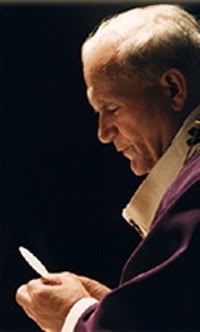
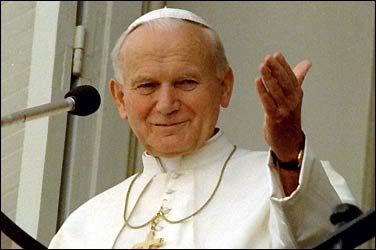
Tuesday, February 01, 2005
Confirmation name
Tonight my priest suggested I start looking for a confirmation name. Hmmmm. Any suggestions? These are the ones I've thought of so far:
St. Veronica Giuliani
St. Anastasia
St. Mary Magdalene
St. Faustina
St. Angela Merici
St. Veronica Giuliani
St. Anastasia
St. Mary Magdalene
St. Faustina
St. Angela Merici
Subscribe to:
Posts (Atom)